
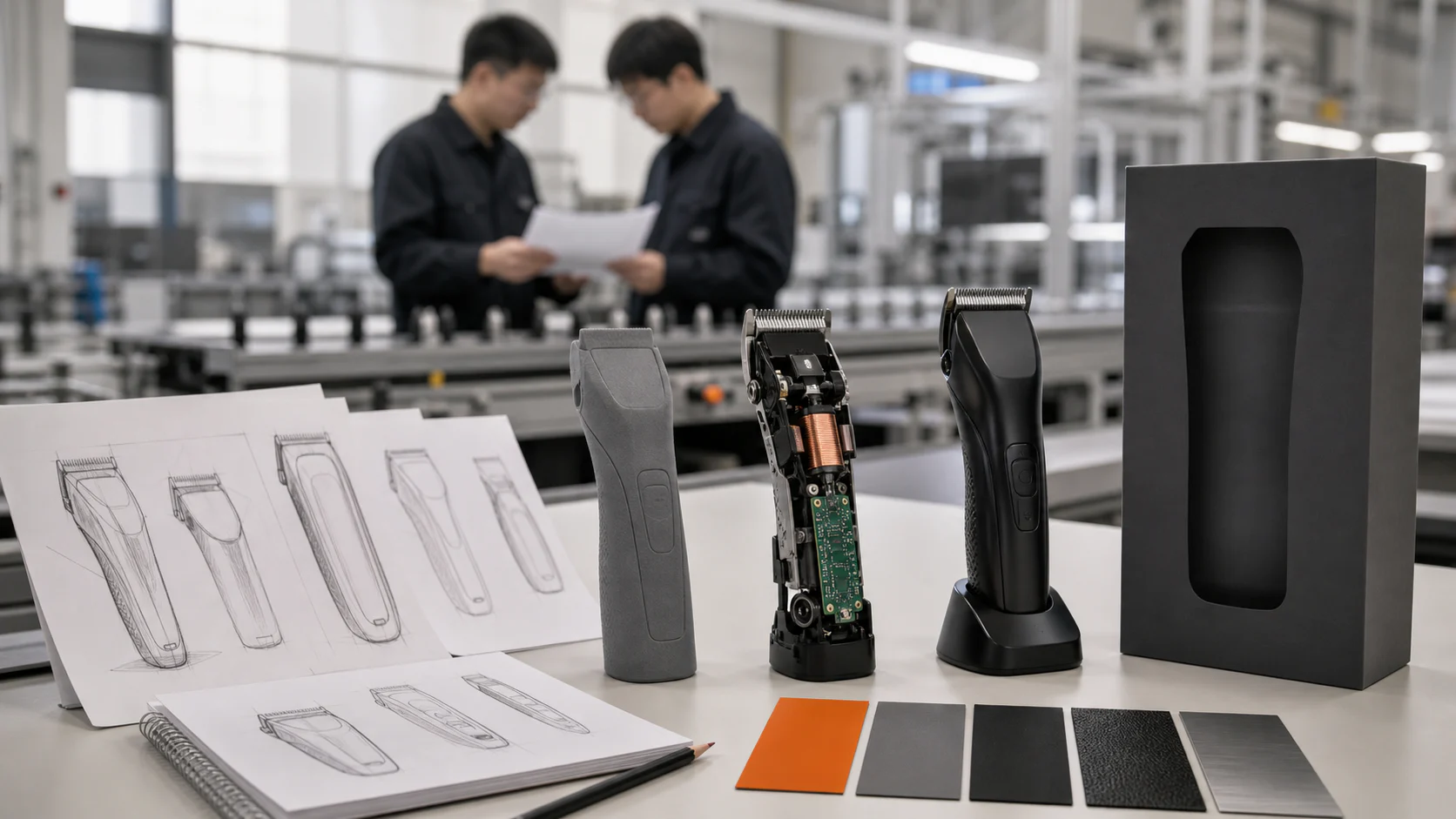
An OEM hair clipper project can be as simple as applying a logo and customized packaging to an existing product, or as complex as developing new housing, electronics, blade geometry, accessories and tooling. These projects should not share the same timeline, MOQ or validation plan.
For a B2B buyer, the purpose of a development process is not to create paperwork. It is to turn commercial requirements into a product configuration that can be tested, priced, manufactured and inspected consistently. Every major decision—from motor and blade to battery, color and carton—should have an owner, an approval point and a record.
This guide explains a practical stage-by-stage OEM and ODM workflow for rechargeable hair clippers. It is written for brand owners, importers, distributors, retail chains, salon suppliers and e-commerce sellers preparing a private-label launch.
Quick answer: what are the main OEM hair clipper development stages?
The main stages are project brief, feasibility review, platform selection, quotation, sample development, testing, design and packaging approval, compliance planning, golden-sample approval, pilot production, mass production, pre-shipment inspection and shipment release. Existing-platform projects can move faster; new tooling or functional changes require more engineering and validation.
OEM, ODM and private label: define the project type first
These terms are used differently across suppliers, so define the work rather than rely on the label.
Private label
The buyer selects an existing product with limited changes such as logo, color from available options, packaging artwork and manual. This is normally the lowest-complexity route.
OEM customization
The project uses a proven platform but changes a broader set of items, such as color, decoration, accessories, blade option, battery capacity, packaging or charging configuration. Technical review is needed to confirm which changes remain within the validated design.
ODM development
The supplier participates in product design or engineering. The project may include new appearance, structural parts, tooling, electronics, functions or accessory systems. It requires defined intellectual-property terms, development charges, sample stages and ownership of tooling and files.
Ask every supplier to state which parts are standard, modified or newly developed. This one table can prevent major misunderstandings later.
Stage 1: Build a commercial and technical product brief
The brief should explain why the product exists and what it must do. A useful hair clipper brief includes:
- target countries and sales channels;
- intended user: home, professional or both;
- target retail and ex-factory range;
- projected first order and annual volume;
- blade type, width and cutting-length needs;
- motor expectation and speed options;
- battery runtime and charging preference;
- waterproof or cleaning requirement;
- display, indicator and control functions;
- guide combs and accessories;
- body color, finish and logo direction;
- plug, adapter and cable requirements;
- packaging structure and languages;
- expected certifications or market documents;
- desired sample and launch dates.
Avoid specifying only marketing features. “Professional motor” and “long battery life” are not measurable. Define the use scenario and allow the engineering team to propose a suitable configuration. If the target requirement is not fixed, mark it as a decision to be made during sample comparison.
Stage 2: Feasibility and risk review
The manufacturer should review the brief across sales, engineering, sourcing, quality and production. The output should identify what is feasible on an existing platform, what requires modification and what remains uncertain.
Typical risk questions include:
- Can the selected motor and battery fit the housing and thermal strategy?
- Does a new blade change motor load, noise or runtime?
- Does the waterproof target require new seals or port construction?
- Will a new color show flow lines, scratches or color variation?
- Does the logo method suit the surface and cleaning exposure?
- Can required accessories fit the target gift-box size?
- Do customization changes affect existing test reports?
- Are critical parts available within the launch schedule?
The review should produce an assumptions list. An assumption is not a promise; it is a point to validate. For example, “Expected runtime is approximately 90 minutes with the proposed battery under the supplier's standard no-load test” should later become a confirmed result under an agreed method.
Stage 3: Select the product platform
Existing platforms reduce engineering time because housing, blade, motor, PCB and assembly processes already exist. However, “existing” does not mean every requested change is automatically safe.
Compare candidate platforms using a structured matrix:
- user and channel fit;
- cutting and handling performance;
- available blade systems;
- battery and charging options;
- current certifications and document scope;
- color and logo options;
- accessory ecosystem;
- MOQ and lead time;
- replacement-part availability;
- target cost.
Request representative samples before final selection. If only one sample is available, treat conclusions about variation cautiously. The site's professional hair clipper selection guide can be used as a separate specification checklist.
Stage 4: Define quotation scope and commercial terms
The quotation should identify the exact configuration. Include model, blade, motor, battery, charging accessories, guide combs, packaging, logo method, color, order quantity, carton information, tooling, sample charges, testing scope, Incoterm and validity.
Clarify which items are one-time charges and which are included in unit price. New molds, color matching, printing plates, certification work, special fixtures and packaging prototypes may be separate.
MOQ should be discussed by SKU. A total order of 5,000 units divided across five colors may be more complex than 5,000 units in one color. Printed packaging and custom components can have their own supplier MOQs.
Payment milestones should correspond to project risk and deliverables. Tooling projects may use staged payments linked to design release, first samples and approval. Purchase orders should reference the final specification rather than only a catalog model number.
Stage 5: Develop functional samples
Sample stages vary by complexity.
Existing sample
A standard sample confirms the basic platform before customization. Evaluate cutting, sound, vibration, heat, charging, runtime, controls, cleaning and ergonomics.
Customized appearance sample
This may include color, logo and packaging mockups. A prototype color process may not exactly reproduce mass-production texture or gloss, so the supplier should state limitations.
Engineering sample
Used when internal parts, tooling, electronics or structure change. It may not have final cosmetic quality. Its purpose is to validate design direction and expose engineering problems.
Pre-production sample
Made with production-intent materials, tooling, components and process wherever possible. It should be close enough to the final product to support approval and inspection criteria.
Label every sample with version and date. Record differences from the intended final product. Uncontrolled samples are a major source of later disputes.
Stage 6: Test the complete product
Testing should connect to product claims, foreseeable use and destination-market requirements. A typical development plan may include:
- blade alignment and cutting evaluation;
- motor startup and speed stability;
- abnormal sound and vibration;
- current draw and power behavior;
- runtime and charging time under defined conditions;
- battery and charging protection checks;
- blade temperature during defined operation;
- switch and adjustment endurance;
- guide-comb attachment cycles;
- housing and packaged-product drop evaluation;
- logo and surface durability;
- cleaning or waterproof testing where claimed;
- packaging fit and transit evaluation.
Not every test needs to be performed on every unit. Development validation, reliability testing and routine production checks serve different purposes. The plan should state sample quantity, method, acceptance criteria and report owner.
When a result fails, record the failure mode, root-cause investigation, corrective action and retest. Replacing the failed sample without understanding the cause does not validate the design.
Stage 7: Finalize industrial design, color and logo
Color approval should use a physical reference where appearance is important. Digital screens cannot reliably define plastic color, gloss or metallic effect. Confirm whether the reference applies to molded plastic, spray coating, printing or packaging, because each process behaves differently.
Logo methods may include pad printing, screen printing, laser marking, hot stamping, labels or molded features. Select the method based on surface, detail, color, cleaning exposure, cost and expected durability. Test adhesion or abrasion using an agreed method.
For new tooling, approve 3D data and critical dimensions before mold release. Define tooling ownership, storage, maintenance, modification approval and end-of-project handling in writing.
Stage 8: Develop packaging and manuals
Packaging is part of product compliance and logistics, not only graphic design. The pack must protect the clipper and accessories, present the product clearly and fit shipping constraints.
The packaging workflow should include:
- dieline confirmation;
- product and accessory layout;
- artwork and copy review;
- barcode and label review;
- language and warning review;
- physical mockup;
- packed-product drop or transport evaluation where required;
- final print proof and signed artwork.
Check claims against validated specifications. Avoid unsupported terms such as “100% waterproof,” “never heats” or “professional grade” without a defined basis. Confirm model, voltage, input, battery information, importer details and disposal marks according to applicable market requirements.
Manuals should explain charging, operation, cleaning, lubrication, storage, blade handling and warnings in language appropriate for the destination market. The final file needs revision control.
Stage 9: Plan compliance and shipping documentation
Compliance planning begins before production. The applicable requirements depend on product construction and destination market; there is no universal certificate package for every hair clipper.
For the EU, manufacturers and other responsible economic operators must determine applicable legislation, perform conformity assessment, prepare technical documentation, issue declarations and apply CE marking where required. CE marking is not a statement that an EU authority has individually approved every product.
Rechargeable clippers also create battery-transport obligations. IATA guidance explains that lithium cells and batteries offered for transport must meet applicable UN Manual of Tests and Criteria, Part III, subsection 38.3 requirements. The shipment may require test summaries, battery information, packaging, marks and documentation depending on configuration and mode.
Ask for a document matrix listing document name, model, component version, issuing party, issue date and responsibility. Verify that customized chargers, batteries or construction remain within scope.
Mid-article CTA — Start an OEM Discussion: Turn your product brief into a development plan. Send the target market, functions, quantity and launch date for an initial feasibility review.
Stage 10: Approve the golden sample and specification
Mass production should begin from a controlled approval package. This normally includes:
- signed product specification;
- approved bill-of-material configuration or controlled component list;
- golden sample;
- color and logo references;
- accessory and packing list;
- approved artwork and manuals;
- inspection criteria;
- agreed test plan;
- purchase order and delivery schedule;
- open-point list with owners and due dates.
The golden sample is a reference, not a substitute for measurable criteria. Appearance tolerances, blade alignment, function and pack contents should be described. Store the buyer and factory reference samples carefully and identify them against the approved revision.
Freeze changes before production. If a change is necessary, evaluate cost, timing, compliance and retest needs, then obtain written approval.
Stage 11: Run pilot production
A pilot run tests whether the design can be built repeatedly with production-intent materials, operators, fixtures and instructions. It is particularly important for new tooling, new electronics, unfamiliar decorative processes or complex packaging.
Pilot review should examine:
- assembly sequence and cycle time;
- part fit and tolerance variation;
- defect modes and rework;
- test fixtures and data capture;
- blade alignment consistency;
- wire routing and fastening;
- logo and appearance yield;
- pack-out completeness;
- carton loading and pallet plan.
Engineering samples can be carefully assembled by a small team; mass production cannot depend on exceptional manual adjustment. A pilot exposes these differences.
Document corrective actions and confirm closure before increasing volume. If the pilot configuration differs from the golden sample, update the approval package.
Stage 12: Mass production and in-process control
Mass production should follow controlled work instructions, approved materials and defined inspection points. Incoming checks may cover blade, motor, battery, PCB, housing, switch, cable, packaging and labels according to risk.
In-process controls may include:
- component verification;
- screw torque or fastening checks;
- wire and seal placement;
- blade assembly and alignment;
- function and charging checks;
- abnormal sound screening;
- appearance inspection;
- accessory count;
- packaging scan and weight control.
The factory should have a reaction plan for failures. A rising defect trend may require line stop, segregation, root-cause analysis and re-inspection. Rework must use approved instructions and leave the product compliant with the final specification.
Buyers should receive production status based on meaningful milestones: material ready, assembly started, packing started, internal inspection completed and shipment inspection scheduled.
Stage 13: Pre-shipment inspection
Agree on the inspection plan before production. ISO 2859-1 provides statistically based acceptance-sampling schemes indexed by AQL for lot-by-lot inspection. The buyer should select sampling and acceptance rules appropriate to product risk and contract terms.
Inspection may include:
- order quantity and SKU breakdown;
- product and packaging workmanship;
- model, color, logo and markings;
- function, charging and indicators;
- blade, switches and guide combs;
- accessories, manuals and pack count;
- barcode and label checks;
- carton dimensions, weight and marks;
- selected tests specified in the inspection checklist;
- photo evidence and defect classification.
Define critical, major and minor defects for the product. A wrong voltage label or unsafe blade projection is not equivalent to a small cosmetic mark. The agreement should state what happens after failure: sorting, rework, corrective action, re-inspection or hold.
Shipment inspection is not a replacement for process control. It is the final verification of a sample from a completed lot.
Stage 14: Shipment release and logistics preparation
Before release, confirm inspection status, commercial invoice, packing list, carton data, battery documents, certificates or declarations required by the transaction, booking information and destination labels.
For rechargeable products, coordinate early with the forwarder. Air, sea and courier requirements may differ, and rules can change. Do not assume that a previous shipment's paperwork automatically applies to a changed battery or route.
Retain production and shipment records according to contractual and regulatory needs. Keep traceability for product model, batch, battery and critical component versions where applicable.
Stage 15: Post-shipment review and continuous improvement
Development does not end when goods leave the factory. Review receiving inspection, customer service questions, return reasons, reviews and sell-through feedback. Separate product defects from unclear instructions, transport damage and expectation mismatch.
Use the first order to improve:
- user instructions;
- packaging protection;
- accessory organization;
- inspection criteria;
- replacement-part stock;
- production fixtures;
- future model specifications.
Agree on how confirmed defects are investigated. Useful corrective action identifies root cause, containment, affected batches and prevention—not only replacement quantity.
Typical timeline factors
There is no responsible universal timeline. Existing-platform private-label projects may progress relatively quickly once artwork and samples are approved. New colors, accessories or component changes add purchasing and validation time. New tooling and electronics require design, prototype, mold, pilot and compliance stages.
The critical path often includes:
- buyer decision speed;
- sample shipping and testing;
- color and artwork approval;
- tooling modification;
- critical-component lead time;
- certification or report updates;
- packaging printing;
- production capacity;
- inspection and booking windows.
Build the schedule backward from the required warehouse date, not only the factory completion date. Include inspection, export preparation, transit, customs and receiving buffers.
Common OEM project mistakes
Starting artwork before freezing the configuration
Changing accessories, input ratings or claims after artwork approval creates rework and compliance risk.
Approving by chat messages only
Consolidate decisions into a controlled specification and approval record. Chat is useful for speed but weak as the sole project record.
Treating every customization as cosmetic
Battery, blade, motor, charger and sealing changes can affect function, documentation and production control.
Skipping pilot production
A hand-built sample may hide assembly difficulty. Pilot production validates process repeatability.
Planning inspection at the last minute
Define samples, tests, defects and release authority before the purchase order. Otherwise, buyer and factory may interpret quality differently.
Choosing the lowest quote before scope alignment
Compare equivalent batteries, blades, accessories, packaging, tests, terms and documentation. An incomplete quotation is not necessarily a lower total cost.
Frequently asked questions
How long does OEM hair clipper development take?
It depends on project type. Existing-platform private label is faster than new tooling or electronic development. A credible schedule is created after feasibility review and includes buyer approvals, component lead times, testing, packaging, production and inspection.
What information should I send to a manufacturer?
Send target market, channel, user, target price, key functions, quantity, annual forecast, certification expectations, packaging direction and launch timing. Mark mandatory and flexible requirements.
Can I customize the blade and battery?
Possibly, depending on the platform. Both changes require engineering review because they can affect motor load, runtime, heat, charging, internal space, transport documents and existing test-report scope.
When should I pay for tooling?
Tooling terms vary. Define deliverables, ownership, modification approval, maintenance and sample milestones before payment. Link staged payments to documented development outputs where appropriate.
What is a golden sample?
It is an approved physical reference representing the agreed product configuration and appearance. It should be linked to the signed specification and revision. It does not replace measurable inspection criteria.
Is pre-shipment inspection necessary?
It is strongly useful when order value, product risk or buyer policy justifies it. The inspection plan should be agreed before production and complement—not replace—the factory's quality controls.
Who is responsible for certification?
Responsibilities depend on market and contract. Manufacturers, importers and other economic operators may each have legal duties. The project should assign document preparation and verification, but qualified compliance advice is necessary for the final product and destination.
Conclusion
A successful OEM hair clipper project is a sequence of controlled decisions. The buyer defines the market need; the manufacturer translates it into a feasible product; both sides approve samples, specifications, packaging and compliance scope; production then follows documented controls and ends with agreed shipment inspection.
Skipping stages may save days early and cost weeks later. The most efficient process is not the one with the fewest approvals. It is the one that resolves important uncertainty before material commitment and mass production.
CTA: ready to develop a private-label grooming product?
Send your target market, expected quantity, key functions, price position and launch date. YEEPUL can review whether an existing grooming platform, OEM configuration or deeper ODM route is appropriate, then identify the next sample and quotation steps. Contact Us, explore men's grooming platforms or read the guide to choosing a hair clipper manufacturer.