
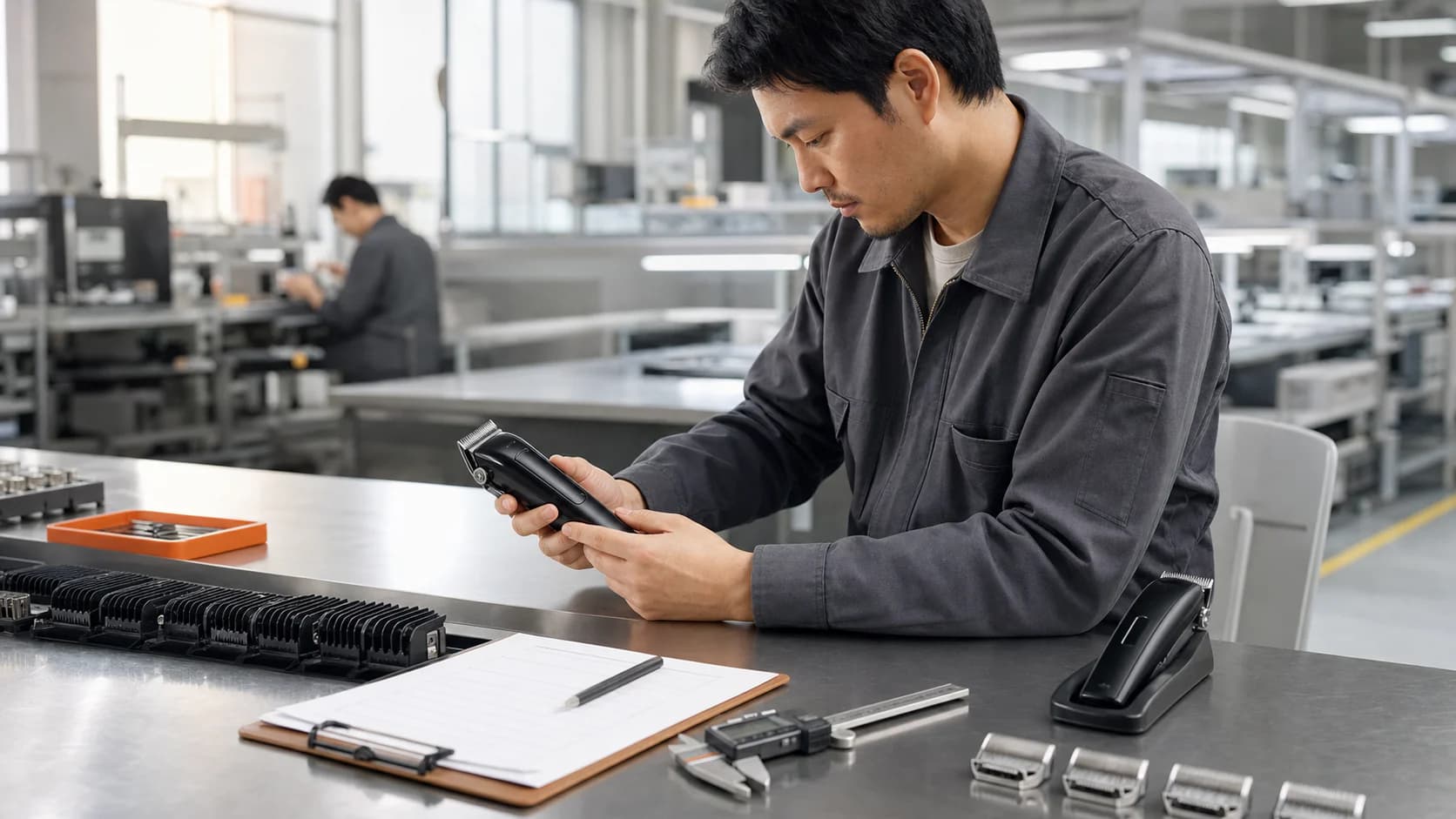
B2B Sourcing Guide: A practical 12-point checklist for importers, distributors and private-label brands.
Choosing a hair clipper manufacturer is not the same as selecting a finished item from a catalog. A buyer is selecting a product platform, a quality system, a communication process and a supply relationship that may continue for several seasons. A visually attractive sample can still become a difficult bulk-order product if the blade system is inconsistent, the battery documentation is incomplete, the packaging has not been transit-tested or production changes are poorly controlled.
The most useful evaluation therefore begins with your market requirements—not with a supplier's largest product list. Define the user, channel, target price, key functions, destination country, expected order volume and launch date. Then evaluate whether a factory can translate those requirements into an approved specification and repeat it during mass production.
This guide provides a practical twelve-point checklist for importers, distributors, private-label brands, wholesalers and e-commerce sellers. It focuses on evidence a buyer can request and observations that can be made during sampling, factory testing and shipment inspection.
YEEPUL is a Wenzhou-based B2B personal-care product supplier serving overseas brand owners, distributors and professional-channel buyers. Its product range covers hair clippers, beard trimmers, electric shavers, grooming kits, hair dryers and women's grooming products. For OEM/ODM projects, the discussion starts with the buyer's market, channel and specification before moving to product selection, samples, customization and production planning.
Quick answer: what should you look for in a hair clipper manufacturer?
A suitable manufacturer should demonstrate relevant product engineering, documented specifications, controlled component sourcing, repeatable assembly, functional testing, compliance support, realistic capacity planning and transparent pre-shipment inspection. The best supplier is not automatically the one with the lowest quotation or the widest catalog. It is the supplier whose product platform and production controls fit your market risk, volume and brand position.
1. Start with a written sourcing brief
Before comparing factories, create a one- or two-page brief. Include the product type, intended user, sales channel, target market, target ex-factory range, estimated first order, annual forecast, battery and charging preference, waterproof requirement, blade preference, accessory list, packaging concept and desired certification support.
Separate requirements into three groups:
- Must have: conditions without which the product cannot launch.
- Preferred: features that strengthen the offer but can be adjusted.
- Open to recommendation: areas where the manufacturer may propose a proven platform.
This structure prevents a common sourcing problem: receiving quotations for products that look similar but are not technically comparable. It also helps the supplier identify conflicts early. For example, a compact housing, long runtime, high motor output and low target cost may not be achievable together without changing the battery, motor or accessory scope.
2. Confirm relevant product specialization
A factory that assembles many small appliances may not have deep experience with hair clippers. Ask which grooming categories are produced regularly, which blade systems are used, how motor and blade combinations are validated, and whether replacement parts are available.
Relevant specialization should be visible in the engineering questions the supplier asks. A capable team will want to know the target hair types, professional or household use, desired cutting length, guide-comb system, wet-cleaning claim, charging environment and expected duty cycle. If the discussion remains limited to color and logo, the evaluation has not yet reached the product-engineering level.
Request recent, anonymized examples of comparable platforms rather than customer-confidential information. Useful evidence may include sample specifications, test-item lists, assembly work instructions or a general flowchart. Avoid asking a supplier to reveal another brand's drawings, pricing or packaging.
3. Evaluate the product platform, not only the appearance
Two clippers with similar housings can perform differently because of the motor, eccentric drive, blade pressure, tooth profile, battery, PCB logic and assembly tolerance. During sample evaluation, record more than subjective impressions.
At minimum, compare:
- startup consistency and sound;
- vibration at each speed;
- cutting performance under a representative workload;
- blade temperature during repeated use;
- charging behavior and indicator logic;
- runtime under a defined test condition;
- switch and lever feel;
- guide-comb attachment and retention;
- cleaning access and water-contact limits;
- housing gaps, scratches, color variation and printed-mark durability.
Use the same method for every supplier sample. A short video, test log and defect photo library make internal decisions more reliable than comments such as “Sample A feels better.” If you need help defining the product specification itself, compare the verified platforms in YEEPUL's hair clipper product range.
4. Review engineering and change-control capability
Private-label projects often begin with an existing platform, while ODM projects may involve structural, functional or tooling changes. In both cases, ask who owns engineering decisions and how changes are approved.
A practical change-control process should identify the requested change, affected parts, cost impact, timing impact, validation requirement and approval status. This matters because small changes can create unexpected consequences. A different housing material can affect color and drop resistance. A new blade can affect motor load and noise. A higher-capacity battery can affect internal space, charging time, documentation and packaging.
Ask whether drawings, bills of materials, firmware versions and packaging files use revision control. The buyer does not need access to every confidential manufacturing record, but the final approved configuration should be unambiguous.
5. Ask for a clear quality-control plan
“We inspect quality” is not a quality plan. Request the actual control points used for incoming material, assembly, functional testing, appearance inspection, packing and release.
For a rechargeable clipper, relevant checks may include blade appearance and alignment, motor operation, abnormal noise, switch function, charge indication, charging current, battery protection behavior, accessory count, logo position, packaging contents and carton condition. The exact plan should reflect the approved product and agreed claims.
Ask three questions for each important test:
- What is tested?
- What is the acceptance criterion?
- What record or reaction follows a failure?
Factory testing should distinguish development validation from routine production inspection. A long runtime test may be performed on defined samples, while quicker function checks may be applied more broadly during production. The supplier should explain the sampling logic rather than imply that every unit receives every destructive or time-consuming test.
For YEEPUL OEM/ODM projects, quality planning is discussed against the approved model rather than treated as a generic promise. Hair clippers and beard trimmers may place greater emphasis on blade alignment, motor operation and guide-comb fit, while electric shavers and grooming kits may require different checks for shaving heads, attachments, charging behavior and accessory completeness. This product-specific approach helps keep the inspection criteria relevant to the actual order.
6. Understand component and sub-supplier control
Hair clippers depend on purchased components such as batteries, motors, blades, PCBs, switches, chargers, cables and packaging. Ask how critical suppliers are approved and how incoming materials are checked.
The goal is not to demand a fully vertically integrated factory. Specialized component suppliers can be an advantage. The important issue is whether the manufacturer defines requirements, qualifies components and controls substitutions. A battery cell, motor or blade should not be changed silently after sample approval because it is temporarily cheaper or easier to source.
Discuss continuity for replacement blades, guide combs and chargers. For distributor and professional channels, spare-part availability can influence customer satisfaction more than an additional marketing feature.
7. Verify compliance support for the destination market
Do not ask only, “Do you have CE?” Compliance depends on the final product configuration, power supply, battery, intended use and destination market. Ask which reports and technical documents apply to the selected model and whether customization changes their scope.
For the European market, CE marking is a manufacturer's declaration that the product meets applicable EU requirements; it is not a universal certificate issued by one central EU authority. The responsible economic operators must ensure that applicable conformity assessment, technical documentation and declarations are in place. Requirements may involve electrical safety, electromagnetic compatibility, restricted substances, batteries, labeling and other rules depending on the configuration.
Rechargeable products also require transport preparation. Lithium cells and batteries offered for transport must meet applicable UN 38.3 testing requirements, and shipping documents, packaging and marks depend on the battery and shipment mode. Confirm this with the forwarder and compliance specialists for the actual shipment.
Avoid suppliers who treat a report for a different model as automatically valid. Request model identification, issue date, laboratory information and a clear explanation of what the document covers.
YEEPUL can support buyers in reviewing model-specific compliance documentation for target markets, including CE, RoHS, FCC, GS, CB and other applicable requirements where available. The exact reports must still be matched to the final product, battery, charger, plug, labeling and customized configuration before the order is confirmed. Buyers can review YEEPUL's certification support as part of their initial supplier assessment.
8. Check capacity against your real schedule
Published monthly capacity is not the same as available capacity. Ask for a schedule based on your product, packaging and forecast. Clarify the time required for sample approval, material purchasing, color matching, packaging printing, production, inspection and shipment preparation.
If your launch depends on a fixed market window, identify the latest approval dates. Delayed artwork approval or a late function change can move the entire plan. A credible supplier will show these dependencies rather than promise an unrealistic shipping date.
For repeat orders, discuss forecast communication and critical-component lead times. Batteries, customized blades, colored plastics and printed packaging may require earlier commitments than standard accessories.
YEEPUL's production planning is supported by a stated monthly capacity of up to 450,000 units and a 9,000-square-meter office and product development center. Actual availability still depends on the selected model, materials, packaging and approval schedule, so capacity should be confirmed against the specific order. For multi-category programs, the project team can use one consolidated brief to identify which clippers, shavers or grooming kits can move together and which require separate approval milestones. See the About YEEPUL page for the current company profile and capabilities.
9. Compare quotations on the same basis
A low unit price may exclude items included elsewhere. Build a comparison sheet covering:
- exact model and specification;
- included accessories and guide combs;
- charging cable, adapter or plug;
- branded packaging and inner packing;
- logo and decoration method;
- master-carton quantity and dimensions;
- testing or certification scope;
- tooling and sample charges;
- Incoterm and quotation validity;
- MOQ by color and packaging version;
- spare parts and extra accessories.
Ask the supplier to identify cost drivers. This creates better value-engineering discussions. Removing an accessory that customers do not need may be more sensible than reducing blade or battery quality to meet a target price.
10. Assess communication and project ownership
Good communication is not simply a fast reply. It is an accurate reply that records decisions, identifies unresolved questions and distinguishes confirmed information from assumptions.
During sampling, note whether the supplier:
- answers technical questions consistently;
- shares updated specifications after changes;
- flags risk before approval;
- confirms artwork and color references;
- provides realistic dates;
- explains failures and corrective actions;
- protects customer confidentiality.
Ask who will manage the project after the sales discussion. A clear contact path between sales, engineering, quality and production reduces information loss.
11. Approve a golden sample and final specification
Do not approve mass production from photographs alone when the product risk justifies a physical sample. The approved sample—often called a golden sample—should match the signed specification, packaging artwork, accessory list and approved color reference.
Record any accepted limitations. For example, if a decorative surface has a defined tolerance or if a battery display changes in steps rather than continuously, it should be understood before production. Unwritten expectations are difficult to inspect later.
Keep one approved sample with the buyer and one controlled sample with the factory when practical. The reference should be protected from uncontrolled use or replacement.
12. Plan pre-shipment inspection before placing the order
Shipment inspection should not be invented when the cartons are already sealed. Agree on timing, sampling approach, defect categories, tests, document access and release authority in the purchase order or quality agreement.
ISO 2859-1 provides acceptance-sampling schemes indexed by AQL for lot-by-lot inspection. An AQL plan does not promise that a shipment contains exactly a stated percentage of defects. It provides a statistical sampling and acceptance framework. The selected inspection level and acceptance limits should reflect product risk, contractual requirements and the buyer's quality strategy.
A practical hair clipper pre-shipment inspection may cover:
- quantity and assortment;
- workmanship and cosmetic defects;
- function, charging and indicator behavior;
- blade, switch, comb and accessory checks;
- product and packaging markings;
- manuals and pack contents;
- barcode scan and label position;
- carton dimensions, weight and condition;
- selected safety or performance checks defined in the inspection plan.
If defects exceed agreed limits, the next step may be sorting, rework, re-inspection or shipment hold. The process should define who decides and who pays for additional work.
A practical supplier scorecard
Use a weighted scorecard rather than selecting by intuition. A typical structure may assign 20% to product fit, 20% to quality system, 15% to engineering, 15% to compliance support, 10% to commercial terms, 10% to delivery planning and 10% to communication. Adjust the weights for your business.
A professional barber-supply brand may give more weight to blade consistency, thermal behavior and spare parts. A promotional or high-volume distribution program may prioritize cost control, packaging execution and delivery reliability. The scorecard should reflect the program—not a generic idea of the “best factory.”
Frequently asked questions
What is a reasonable MOQ for an OEM hair clipper?
YEEPUL's standard MOQ is 3,000 units. The practical order structure still depends on the existing platform, housing color, logo method, packaging, component purchasing and production setup. Using an existing model with standard materials normally requires less commitment than custom tooling or a new electronic design. Confirm MOQ by SKU, color and packaging version.
Should I audit the factory before ordering?
An audit is valuable when order value, brand risk or technical complexity justifies it. The audit may be performed by the buyer or an independent party. It should examine the actual production and quality processes relevant to the product, not only licenses and presentation rooms.
How many samples should I test?
One sample can confirm appearance and basic function, but it cannot show normal variation. The appropriate sample quantity depends on project risk and development stage. Comparative testing across multiple samples is especially useful for sound, blade alignment, runtime, color and assembly consistency.
Can one report cover every customized version?
Not automatically. Changes to electrical parts, battery, charger, materials, construction or intended claims may affect applicability. Confirm the scope with the manufacturer and qualified compliance professionals before production.
What is the difference between a factory test and a shipment inspection?
Factory tests control the process during incoming inspection, assembly and production. Shipment inspection checks a defined sample of finished goods against agreed requirements before release. Both are useful; one does not replace the other.
Conclusion
Choosing a hair clipper manufacturer is an evidence-based risk decision. Begin with a clear sourcing brief, compare equivalent configurations, test representative samples, verify the quality plan, confirm compliance responsibilities and define shipment inspection before ordering. Price remains important, but a low quotation cannot compensate for unclear specifications, uncontrolled component changes or missing documentation.
The strongest supplier relationship is built on a shared definition of the product and a transparent method for approving changes. When those foundations are in place, OEM color, logo, packaging and range expansion become easier to manage.
Looking for a Hair Clipper Manufacturing Partner?
Share your target market, sales channel, required functions, expected quantity and launch timing. YEEPUL can review your brief, recommend a relevant grooming platform and prepare a practical sample-and-quotation route. Explore the hair clipper product range or contact our team to request a quote.