
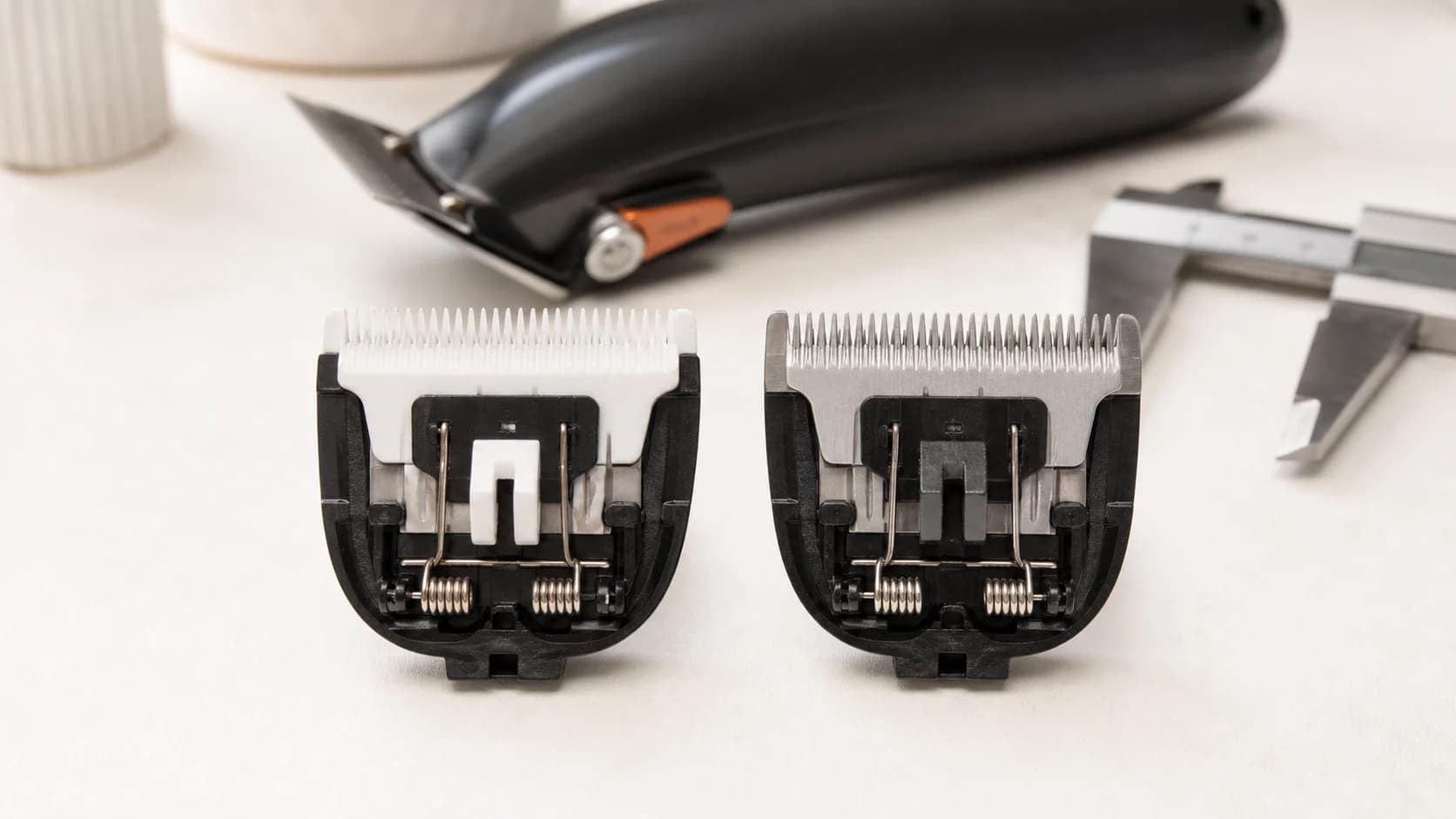
A practical comparison of heat, wear, impact tolerance, corrosion, cutting performance and product positioning for brand owners, importers and distributors.
Ceramic and stainless steel clipper blades are often compared with a simple claim: ceramic stays cooler, while steel is stronger. That summary is useful, but it is not enough for a brand owner, importer or distributor choosing a product platform. The cutting system is affected by the fixed blade, moving blade, tooth geometry, surface finish, contact pressure, lubrication, motor, drive mechanism, housing alignment and user maintenance. Changing one material does not automatically produce a better clipper.
The correct question is therefore not “Which material wins?” It is “Which blade system fits the intended user, product position, operating conditions, service plan and target cost?”
This guide compares the two material directions from a B2B product-selection perspective. It also explains what to test on samples before approving a blade claim or placing a bulk order.
Quick answer
Stainless steel is a practical mainstream choice because it can provide good edge performance, impact tolerance, corrosion resistance and predictable replacement cost. Ceramic moving blades can support lower heat transfer and wear resistance in suitable designs, but they are more brittle and require careful geometry, assembly and handling. Neither option guarantees cutting comfort or long service life. Sample testing of the complete clipper is more reliable than selecting by material name alone.
What does “ceramic blade” usually mean in a clipper?
In many electric clipper systems, “ceramic blade” refers to a ceramic moving cutter paired with a steel fixed blade. It does not necessarily mean that every cutting component is ceramic. The ceramic part is often based on zirconia, but buyers should confirm the actual construction with the manufacturer rather than infer it from color.
Likewise, “stainless steel blade” is a broad description. Steel grade, heat treatment, hardness, grinding, coating and finishing all affect performance. A material label without a drawing, specification or test result cannot describe the complete blade.
Product example: a combined ceramic-and-steel blade system: The current YEEPUL YMC101 Professional Cordless Hair Clipper uses a black-plated stainless-steel fixed blade with a ceramic moving blade, directly illustrating the hybrid construction described above. Its published configuration also includes a 2000 mAh Li-ion battery, 150-minute working time, three-hour charging and eight guide combs from 1.5 to 19 mm. For a B2B buyer, this makes the model a relevant sample platform for comparing blade temperature, alignment, runtime and accessory positioning under controlled conditions.
When comparing quotations, ask the supplier to state:
- fixed-blade material;
- moving-blade material;
- blade width and tooth profile;
- surface coating, if any;
- adjustment or taper mechanism;
- replacement-blade availability;
- compatibility with other models;
- cleaning and lubrication instructions.
This information turns a marketing phrase into a configuration that can be sampled and controlled.
Ceramic vs stainless steel at a glance
| Decision factor | Ceramic moving blade | Stainless steel moving blade |
|---|---|---|
| Heat transfer | Often feels cooler under comparable use, but complete-system heat still matters | Conducts heat more readily; lubrication, pressure and workload strongly affect temperature |
| Wear behavior | Hard, wear-resistant material in suitable contact conditions | Depends on grade, treatment, edge and coating; can provide durable mainstream performance |
| Impact tolerance | More brittle; chips or cracks can occur after impact or poor assembly | Generally more tolerant of drops, shock and adjustment |
| Corrosion | Ceramic itself does not rust; the steel fixed blade and hardware still require care | Stainless steel is corrosion resistant, not corrosion proof; drying and lubrication remain important |
| Cost | Often higher component and replacement cost | Broad cost range and mature supply base |
| Service | Requires clear handling and replacement guidance | Familiar maintenance and wider replacement familiarity |
| Market fit | Premium, professional or heat-focused positioning when validated | High-volume distribution, professional and value-premium ranges depending on execution |
The table identifies tendencies, not guaranteed outcomes. A well-designed steel system can outperform a poorly aligned ceramic system, and a ceramic cutter may not solve heat caused by excessive pressure or an inefficient drive.
Note: These are general tendencies. Final performance depends on the complete blade, motor, drive and assembly system.
Heat: why material is only part of the answer
Heat develops through friction, motor operation and energy losses in the drive system. Blade material influences how heat is generated, transferred and perceived, but other variables can dominate the result.
Important variables include:
- moving-blade pressure against the fixed blade;
- lubrication condition;
- blade cleanliness;
- motor speed and load;
- eccentric-drive geometry;
- tooth contact and surface finish;
- continuous operating time;
- hair density and cutting technique;
- ambient temperature.
Ceramic has lower thermal conductivity than steel, so a ceramic moving cutter may transfer heat differently. That does not mean the blade assembly remains cold during unlimited use. The steel fixed blade can still warm, and poor lubrication can increase friction.
For professional positioning, define a repeatable test. Run the same models at the same speed, starting temperature and workload. Record blade-surface temperature at fixed intervals and note noise, current draw and cutting behavior. Do not compare one freshly lubricated sample with another dry sample.
Wear and edge retention
Ceramics used for cutting components are hard and can resist abrasive wear. This is one reason ceramic moving blades are promoted for longer edge retention. However, high hardness is not the same as unlimited life. Wear depends on the mating blade, load, contamination, surface finish and contact pattern.
Steel blade performance also varies widely. Heat treatment and grinding can change edge durability and toughness. Coatings may be used to adjust friction, appearance or surface behavior, but a coating should be evaluated as part of the specific design.
For a B2B buyer, “stays sharp longer” needs a test definition. Possible evaluation methods include a controlled number of cutting cycles, defined hair media, current-draw monitoring, inspection of tooth damage and a cutting-force or performance criterion. The manufacturer should explain the method behind any durability claim.
Avoid publishing an exact lifetime unless the test conditions are stated and representative. User behavior varies, and maintenance can change the result substantially.
Brittleness and drop risk
Ceramic materials are hard but comparatively brittle. A ceramic cutter can chip if dropped, struck, incorrectly installed or subjected to concentrated force. The risk depends on material composition, geometry and support within the blade assembly.
Steel normally provides greater tolerance for impact and bending. That may be valuable in entry-level distribution, travel products or channels where handling is unpredictable. It can also simplify replacement and servicing.
A product with a ceramic moving blade should include appropriate packaging, blade protection and user instructions. During development, inspect the cutter after drop testing of the complete packaged and unpackaged product according to the agreed plan. A passed housing drop does not automatically mean the blade edge has no micro-damage; the inspection should include the cutting assembly.
Corrosion, cleaning and wet-use claims
Ceramic itself does not rust, but a clipper described as having a ceramic blade still contains steel and metal hardware. The fixed blade, screws, springs and drive parts require suitable materials and maintenance. Stainless steel resists corrosion but can still stain or corrode under salt, chemicals, prolonged moisture or inadequate drying.
Cleaning instructions must match the product construction. “Washable blade,” “rinseable head” and “waterproof body” are not equivalent. If the product carries an IP claim, the tested enclosure configuration and conditions matter. IEC 60529 is the standard that classifies degrees of protection provided by enclosures; an IP rating should be based on appropriate testing, not inferred from appearance.
Ask the factory to define:
- which parts may be rinsed;
- whether the blade must be removed;
- whether the charging port needs a cover;
- drying and lubrication steps;
- cleaning agents that should not be used;
- the exact waterproof claim supported by testing.
Cutting performance depends on geometry and alignment
Hair enters the space between fixed and moving teeth. Tooth spacing, rake, edge finish, blade overlap and movement determine feeding and cutting behavior. A ceramic cutter with unsuitable geometry can pull hair. A steel cutter with precise geometry and stable contact can cut cleanly.
Blade alignment also affects skin safety. An aggressive zero-gap setting may appeal to some professional users but increases risk if the moving blade projects beyond the safe position. Products intended for broad consumer use need an adjustment range and assembly method that match the safety strategy.
During factory evaluation, request blade-alignment criteria and the method used on the line. Visual checks may be supported by fixtures or gauges. The final requirement should be written rather than left to operator judgment alone.
Noise and vibration
Changing the moving blade changes mass, contact behavior and sometimes drive load. This can alter sound and vibration. A ceramic cutter is not inherently silent. Loose tolerances, excessive contact pressure, an unstable drive or housing resonance can create objectionable noise with either material.
Compare samples using the same battery state and speed. Record sound at a consistent distance and environment if noise is a key selling point. More importantly, listen for irregular clicking, blade chatter or changes under load. A single decibel number cannot describe an unpleasant sound signature.
Battery and motor interaction
The blade system is part of the motor load. Higher friction or poor alignment can increase current draw, reduce runtime and increase heat. A supplier proposing a blade change should confirm whether motor, eccentric drive, battery and firmware settings remain suitable.
This is especially important when converting an existing steel model to a ceramic cutter for marketing differentiation. The change may appear simple, but it still requires comparative validation. Monitor startup, current draw, speed stability, runtime and temperature on multiple samples.
For example, the published YMC101 configuration combines a ceramic moving blade with a black-plated stainless-steel fixed blade, a 2000 mAh battery and a stated 150-minute working time. Those figures provide a useful validation baseline; if the blade material, contact pressure or drive is changed, runtime, temperature and cutting stability should be retested rather than assumed to remain unchanged.
Replacement blades and after-sales planning
Blade replacement strategy matters for professional distributors and brands expecting multi-year sales. Ask whether the blade is a proprietary format, how long it will remain available, whether moving cutters are sold separately and how replacement is performed.
Ceramic replacement cutters may need more protective packaging. Instructions should prevent over-tightening or incorrect alignment. Steel blade sets may be familiar to service technicians, but compatibility should still be confirmed by model.
If the product will be sold through salons or barber-supply channels, consider listing replacement part numbers at launch. A durable after-sales system can create more trust than an unsupported “long-life blade” claim.
Cost and product positioning
Blade cost should be considered with the complete product economics. Component cost, assembly yield, breakage risk, spare-part packaging, warranty exposure and marketing value all matter.
Ceramic can support a premium story when the product delivers a measurable benefit under the target application. It should not be selected only because the white cutter is visually distinctive. Stainless steel can support both value and professional products, depending on grade, processing and system design.
For a multi-model range, one practical strategy is to use a reliable steel system in the core model and offer a validated ceramic moving blade in a higher tier. This creates a clear comparison without forcing every customer into the same cost structure.
A sample test plan for B2B buyers
Test at least several units per configuration when project risk justifies it. One sample cannot show production variation. Use an approved test sheet and keep samples identified.
1. Incoming visual check
Inspect tooth condition, finish, color, contamination, blade gap, screw condition and packaging. Photograph any chip, burr, scratch or alignment issue.
2. No-load function
Check startup, each speed, abnormal noise, vibration and switch behavior. Note whether performance changes as battery state falls.
3. Cutting comparison
Use the same representative hair medium, technique and number of passes. Record pulling, clogging, cutting speed and remaining uncut fibers. Real user trials may supplement bench comparison, but they should follow safety and ethical requirements.
4. Temperature test
Start samples at a controlled temperature, operate them under equivalent conditions and measure the same blade location at defined intervals. Record lubrication condition.
5. Runtime and charging
Compare complete-system runtime and charging behavior after the blade configuration change. Monitor abnormal temperature and indicator logic.
6. Cleaning cycle
Follow the intended cleaning instructions repeatedly. Inspect corrosion, residue, lubrication need, screw condition and blade movement.
7. Drop and transport evaluation
Evaluate the complete product and packaging according to the agreed plan. Inspect ceramic components carefully after impact, even if no external housing damage is visible.
8. Extended cycling
Run a defined durability schedule and inspect cutting performance, sound, current draw and tooth condition at intervals. The schedule should reflect the product claim rather than use an arbitrary cycle count.
Ask for product samples before fixing the blade specification: Use a current reference platform such as the YMC101 to compare the ceramic moving blade and steel fixed blade as a complete system. Share your channel, target price and expected workload when requesting samples, then confirm all final specifications against the approved sample and quotation.
Which blade should different buyers consider?
Professional barber-supply brands
Evaluate blade temperature, cutting speed, alignment control and replacement availability. Ceramic may be attractive for continuous-use positioning, but impact handling and spare cutters need planning. A high-quality steel system can also be professional-grade.
High-volume distribution and promotional channels
Prioritize predictable cost, impact tolerance, simple maintenance and low return risk. Stainless steel is often practical, provided corrosion resistance, edge quality and assembly are validated.
E-commerce brands
Both options can work. Make sure the feature can be explained accurately and supported by images, instructions and replacement availability. Avoid absolute claims that customer use can easily contradict.
Travel and compact products
Consider drop exposure, blade protection and limited cleaning routines. A robust steel assembly may be useful, although product-specific testing should decide.
Premium home grooming kits
The blade should fit the overall tier. Motor stability, accessory quality, battery experience, packaging and after-sales support must match the premium blade story.
Common purchasing mistakes
Selecting from a material name alone
“Ceramic” and “stainless steel” do not specify geometry, grade, finish or system performance. Request a complete blade description and sample.
Testing only one new sample
Variation can be more important than best-case performance. Compare multiple identified units and retain records.
Ignoring the fixed blade
A ceramic moving cutter still operates against a fixed blade. Its material, finish and contact condition influence heat and wear.
Publishing unsupported temperature claims
“Never gets hot” is not credible. State measured results only with defined conditions, and use qualified wording.
Forgetting replacement supply
A product may sell successfully for years. Confirm spare-part continuity, packaging and customer instructions before launch.
Frequently asked questions
Do ceramic clipper blades stay cooler than steel?
They often transfer heat differently and may feel cooler in comparable designs, but operating temperature also depends on contact pressure, lubrication, motor load, workload and the steel fixed blade. Test the complete product under repeatable conditions.
Are ceramic blades sharper?
Sharpness is determined by edge geometry and finish, not material name alone. Ceramic can maintain an edge under suitable conditions, while precisely processed steel can also deliver excellent cutting performance.
Can a ceramic clipper blade break?
Yes. Ceramic is hard and wear resistant but more brittle than steel. Chipping or cracking can occur from impact, incorrect installation or concentrated force.
Do stainless steel blades rust?
Stainless steel is corrosion resistant, not corrosion proof. Moisture, salts, cleaning chemicals and poor drying can cause staining or corrosion. Follow the manufacturer's cleaning and lubrication instructions.
Is ceramic always better for professional clippers?
No. Professional suitability depends on cutting stability, heat, ergonomics, replacement parts, durability and service support. Either material can be appropriate in a well-engineered system.
Should blade material be included in the product specification?
Yes. Specify fixed and moving blade materials, configuration, appearance, alignment, replacement part and approved sample. Include validated claims and test criteria where relevant.
Conclusion
Ceramic and stainless steel are two valid blade directions with different trade-offs. Ceramic moving cutters may offer attractive thermal and wear behavior, while stainless steel provides familiar toughness, supply flexibility and broad cost options. The result depends on the whole clipper, not one material.
For a defensible purchasing decision, compare multiple samples using the same workload, lubrication, temperature intervals and inspection criteria. Confirm replacement supply and document the approved blade configuration before production. This approach produces a more reliable product than choosing from a specification headline.
CTA: need help selecting a blade system?
Send your target market, sales channel, desired price tier, expected operating pattern and current product reference. YEEPUL can recommend suitable sample platforms for a controlled comparison. Buyers interested in a combined blade configuration can also review the YMC101 product page before sending requirements for quotation and sampling.